When the sales rep doesn't know the product: why promotions die on calls (Part 2)
 Igor Pavlysheninternet marketer
27 March 20256 min read
Contents 9 sections
- Why customer service isn't bureaucracy but money
- The product is a book the sales team must know to the last page
- What I hear on calls every month
- Sabotaging promotions: how a company cuts its own conversion
- Why reps sabotage promotions (often unconsciously)
- What to do: a practical 7-day protocol
- A mini script that usually works better than pushing
- What an owner or head of sales should check every week
- Takeaway
About the customer. About the product. About the sales team. (Part 2) First, I promised to post the next part “the next day” but published it later. So I'm keeping my word now and paying off the debt with something useful.
After another batch of call recordings I picked out a second painful topic. And the deeper I go, the louder one question gets: why is it often the marketer, not a dedicated quality team, who reviews calls? But looking at the results, it's clear: without proper customer service the company loses money exactly where the lead has already reached the sales team.
Customer service, client relations, quality control: call it what you like. Essentially it's a thin bridge between a person and the company, and at the same time the most honest indicator of the sales team's work. No pretty report shows reality like a real conversation with a customer.
Why customer service isn't bureaucracy but money
When a company has no systematic call reviews and feedback, the classic happens: marketing counts leads, the manager looks at summaries, reps insist “these aren't the right customers”, and deals decline.
The main mistake is thinking quality control is a formality. In practice this is exactly where you see:
- where the rep loses the customer's trust in the first minutes;
- how clearly the team communicates the product;
- how objections are handled without pressure or falseness;
- whether promises on timing and follow-up are kept;
- and where paid leads actually burn.
Yes, some processes can be automated: transcription, tags, quick conversation classification. But human service can't be automated yet. A 40-question survey doesn't work, and “rate us from 1 to 5” without reviewing failures is an imitation of care.
In short: if you don't listen to customers systematically, you're not managing sales, just hoping the rep has a good day.
2️⃣ The product is a book the sales team must know to the last page
Is there any point proving again that the product is the center of a business? Everything is built around it: sales, marketing, production, logistics, service, finance. Before the company name and before registering with the tax office, there's the product: its value, its meaning, its place in the market.
Usually at the start the owner sells personally. They feel the product, test the pitch and quickly see what lands and what doesn't. But as the company grows, a sales team appears: in-office, remote, hybrid, doesn't matter. And that's where it gets interesting.
Because when sales pass from the owner to a team, the main thing often gets lost: a deep understanding of the product. The rep knows the price list but not the value. Knows the promotion but not its logic. Knows the script but not the customer.
What I hear on calls every month
I listen to a lot of calls every month. And yes, sometimes I feel embarrassed for someone else's business and genuinely sorry for the ad budget. But almost all weak calls share the same set of problems:
- the product is presented superficially, unrelated to the customer's request;
- promotion terms are stated hesitantly or not at all;
- the rep falls back on “come in, we'll tell you there” instead of facts;
- there's no clear next step and no record of what was agreed;
- the customer doesn't feel truly heard.
In this part I look at the first problem of block #2: sabotaging promotions.
🧂 Sabotaging promotions: how a company cuts its own conversion
A familiar scenario. Marketing built a promotion, the owner approved the economics, the margin was set, materials prepared, traffic warmed up. The sales team nodded: “Yes, got it.” Then come the calls. And here's the most painful part.
Many reps simply don't mention the promotion. And if the customer asks themselves, the answers start drifting: confused terms, unsure delivery, the rep's own distrust of the offer.
From the outside it looks as if the rep isn't helping the customer choose but trying to talk them out of a good deal.
How it sounds in a real conversation
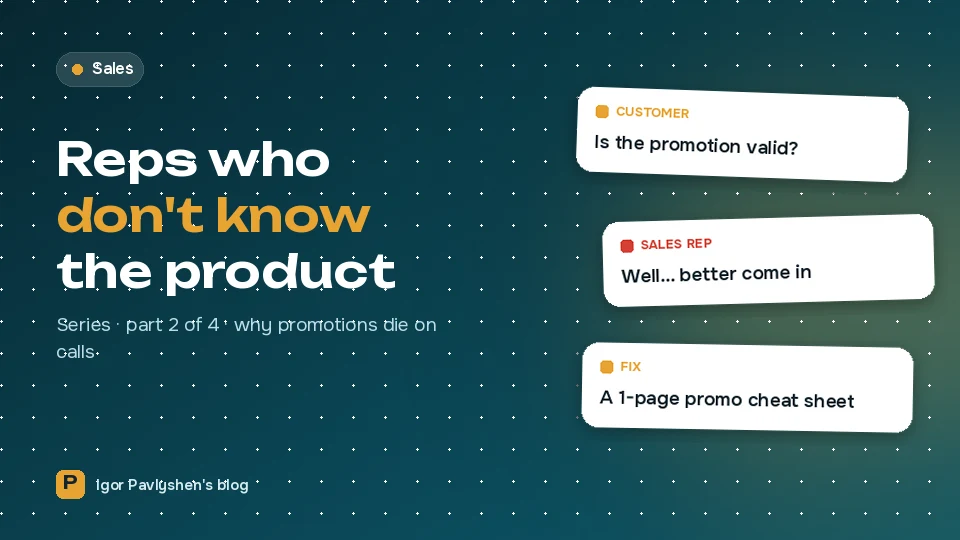
Customer: Your ad mentions a promotion with a bonus. Is it still valid?
Sales rep: Well… we'd need to look, the terms vary, better come in.
Customer: So in short: does it apply to my trim?
Sales rep: I can't say exactly, you'll have to discuss it at the showroom with the manager.
What the customer hears:
- “The rep doesn't understand what they're selling”;
- “They're trying to lure me in without specifics”;
- “The ad and reality probably have different terms.”
Why reps sabotage promotions (often unconsciously)
- They haven't understood how the promotion works. There's no simple cheat sheet: who it's for, what the limits are, how to explain it in 20 seconds.
- They're afraid of making a mistake. It's easier to “steer them to the showroom” than to give a specific answer online.
- They don't believe in the offer's value. If the team sees a promotion as a “marketing trick”, the customer senses it instantly.
- KPIs conflict with reality. When bonuses are paid only for visits, first-contact quality automatically drops.
- There's no quality control. Nobody regularly listens to calls or reviews mistakes based on facts.
What to do: a practical 7-day protocol
Day 1: put all active promotions into one 1-page document. No jargon: simple wording, terms, dates, exclusions, sample explanations for customers.
Day 2: hold a 30-minute session with the reps. The goal: everyone can state the terms in plain language, without “um” and “roughly”.
Day 3: introduce a mini script for presenting the promotion on the first call:
- confirm the promotion is actually valid;
- briefly explain the benefit in money or terms;
- check whether it fits the customer's request;
- offer a next step with a specific time.
Days 4–5: listen to the first 30 calls after the change. Note where the promotion was stated, where it was mumbled and where it sounded confident.
Day 6: give each rep specific feedback on 2–3 moments, not “do better overall”.
Day 7: compare before/after metrics: share of calls with a correct promotion pitch, conversion to the next step, share of repeat contacts.
A mini script that usually works better than pushing
“Yes, the promotion is valid. For your request it gives you [specific benefit]. To save your time, I'll check 2 details now and pick the exact option for you. Would it be convenient to get a selection on WhatsApp within 15 minutes?”
There's no pressure and no attempt to “force a visit at any cost”. There's transparency, respect for the customer's time and a clear next step. That's what converts into a conversation today, and then into a sale.
What an owner or head of sales should check every week
- share of calls where the promotion was stated correctly and without distortion;
- average time to the first clear answer to the customer;
- share of calls with a recorded next step;
- percentage of follow-up service quality calls;
- the top 5 recurring rep mistakes with a correction plan.
Until these metrics are measured, talk about “bad leads” is almost always a convenient excuse.
Takeaway
A product doesn't sell itself. It's sold by the team's understanding of it. If a rep can't explain the value and terms clearly and calmly, ads will bring leads but not enough money.
Sabotaging promotions isn't a “bad people” problem. It's a system problem: training, quality control and management discipline. And it's fixed fast once you stop treating symptoms and start managing first contact based on facts.
In part 3 I'll cover the next block: how reps lose customers at the needs-qualification stage and why a “one-size-fits-all script” works worse today than a normal human conversation.