“The leads are bad” or the sales team is losing 70% of inbound: where the funnel really breaks
 Igor Pavlysheninternet marketer
30 October 20254 min read
Contents 7 sections
“The leads are crap! You set up the ads badly.” Sound familiar? If you're in marketing, you've heard this more than once. And it's usually said before anyone has actually looked at what's happening in the sales team.
On one construction project, lead generation was built with blood, sweat and tears: offer, landing page, sources, anti-fraud, placement filters, all set up and regularly cleaned. 100–150 leads a month come in on a reasonable budget. Formally there's a flow. In fact only 16% are “qualified”.
And no, this isn't about “bad traffic” or junk placements. It's about our beloved sales team.
Math that's usually awkward
In September 128 leads came in (2 more in progress). According to the CRM:
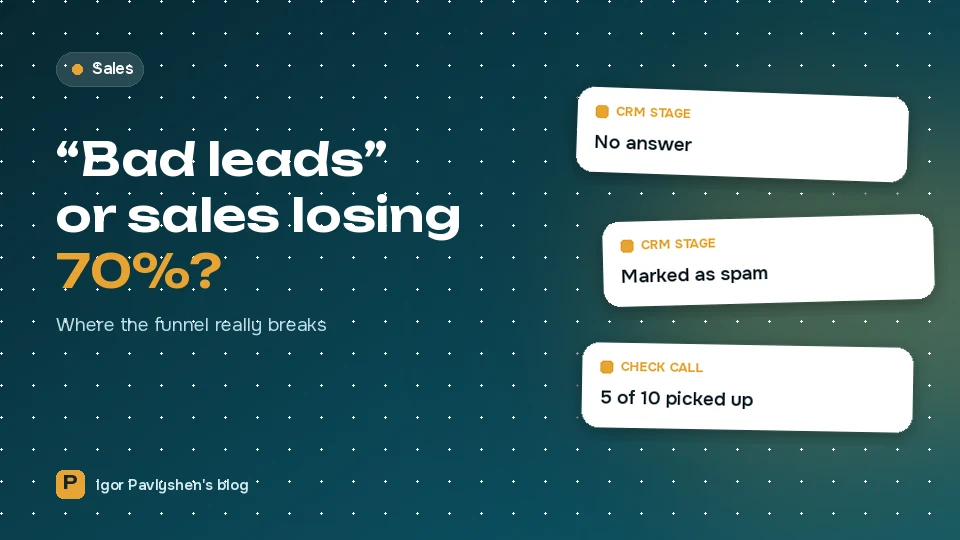
- 42% went to “No answer”;
- 28% marked as “Spam / Poor lead”.
In total, 70% of the inbound flow went down the drain. That's about 90 leads out of 128. And this is with the sales team having a script (sort of): at least 3 call attempts on different days + a check call from a personal number to get past anti-spam filters.
Checking “No answer” in reality
I took 10 leads from the “No answer” stage and called them myself. 5 people picked up on the first try. The rest just rang: perfectly valid contacts that needed proper follow-up and another try.
So at least 50% of the sample weren't “dead” at all. Nobody just followed up properly.
When the sales team is lazy or handles inbound leads as a formality, marketing gets labeled “bad traffic”, and the business loses money twice: on ads and on lost revenue.
Why this happens
- Calling as a formality instead of a process. Leads get closed out faster than anyone tries to reach them.
- Wrong loss reasons in the CRM. “Spam” is used as a catch-all bin for anything inconvenient.
- No daily control by the head of sales. Scripts exist on paper but not in practice.
- Marketing and sales look at different numbers. One counts CPL, the other counts “how the leads feel”.
- The anti-spam reality of 2025+. Answer rates are falling for everyone, so the old handling norms no longer work.
What a marketer should do even if “it's not your area”
Yes, formally this is sales' territory. But if you don't check how leads are handled, one day you'll hear: “you're sending us junk”. So a minimum of control is essential.
- Once a week take a control sample of “No answer” and “Spam”.
- Count not only CPL but also the share of properly handled leads.
- Send the head of sales specific cases, not “it's bad in general”.
- Record CRM status distortions in a separate report.
- Separate “couldn't reach” from “didn't really try to reach”.
This isn't for conflict with sales but for training ad campaigns properly. Because if the CRM picture is distorted, the CRM + analytics setup starts training your ads on junk.
A practical 14-day protocol
- Introduce a mandatory standard of 5+ touches per lead within 7 days (call, messenger, repeat call, SMS/WhatsApp, final touch).
- Ban marking a lead as “Spam” without a confirming criterion (duplicate, obvious fraud, junk number, etc.).
- Every day the head of sales manually checks 10 closed “No answer” leads.
- Once a week marketing checks at least 20 leads in disputed stages.
- On day 14 compare: answer rate, “spam” share, share of valid conversations, cost per valid contact.
If after that “the leads are still bad”, then we look at the advertising side. But honestly and based on data, not emotions.
A mini hack for check calls
When checking a disputed number, you can use a neutral “sorry, wrong number” approach and see whether the contact works at all. Sometimes this instantly shows the lead is alive and the CRM stage is fake.
The ethics are simple: the goal of the check isn't to deceive anyone but to understand the quality of the company's process.
Takeaway
Marketing and sales are one funnel. If the ad input is fine but sales has a 70% hole, don't fix it by switching placements and “new creatives”. Fix lead handling discipline.
Check the sales team even if it's “not your job”. It protects the client's budget, your reputation and the quality of the data you later train your ads on.
I'll cover anti-spam call filters separately, and how to build calling in 2025–2026 without wasting hot inbound leads.