Behind the counter: why an inbound lead isn't a sale (Part 4)
 Igor Pavlysheninternet marketer
29 March 20254 min read
Contents 9 sections
- Working behind the counter
- Why the “counter” no longer works
- Questions that are almost never asked but drive conversion
- What happens when needs aren't discovered
- Now is the time of people, not counters
- In practice: how to rebuild the first contact in 10 minutes
- A line that replaces pressure and works better
- Checklist for the head of sales and the owner
- Takeaway
About the customer. About the product. About the sales team. (Part 4) Background: Part 1, Part 2, Part 3.
In this part I look at another problem heard on calls in almost every industry. I'll call it simply: working behind the counter.
🧂 Working behind the counter
Most reps handling inbound traffic secretly expect a “quick sale”. The logic is clear: if the customer called or submitted a request, they're ready to buy, so all that's left is to name the terms and close the deal.
In practice this approach breaks the consultation from the first minutes. The rep waits for the customer to act instead of leading the conversation. Needs discovery collapses, hardly any questions are asked, and irritation can be heard: “Well, you called, what else do you want?”
An inbound lead isn't a ready sale. It's the start of a conversation. And if that conversation isn't built, the customer leaves even with a good offer.
Why the “counter” no longer works
The classic mistake is selling a complex product as if it were a loaf of bread: walk up, hand over the money, leave with the goods. But buying a house, a car or an expensive service works differently.
For a deal to happen, the rep must:
- understand the customer's situation, not just their literal request;
- discover the real purchase motivation;
- address risks and fears before the customer voices them;
- offer a way to choose, not just a price;
- then guide the person step by step to a decision.
Without this you compete only on discounts, bonuses and “who's cheaper”. And in that race there's always someone who undercuts harder.
Questions that are almost never asked but drive conversion
I very rarely hear simple but powerful questions on calls. The ones that uncover needs and help sell not “hardware” but a solution:
- “Who will live in this house and how do you plan to use the space?”
- “How will you use the car: family, work, highway trips, city?”
- “Which options have you already looked at and why didn't they suit you?”
- “What matters most to you: comfort, status, savings, timing?”
- “What would be the ideal result of this purchase a year from now?”
These questions give a basis for arguments. Without them the rep is left with one tool: price.
What happens when needs aren't discovered
- The pitch misses the target. The rep talks about things that don't matter to the customer.
- Objections multiply. The customer doesn't see the link between specs and their needs.
- The comparison turns into “who's cheaper”. The value isn't packaged, so all that's left is haggling.
- Trust drops. The customer feels unheard.
- The deal goes to a competitor who gives proper advice.
Now is the time of people, not counters
The era of scarcity is over. Customers don't have to “take what's available”. They have choice, speed and access to information. So today the winner isn't whoever pushes hardest but whoever guides most conveniently and precisely.
People want three things:
- a comfortable and clear process;
- fast and honest information;
- a personal benefit in the context of their needs.
If you give them this, you sell. If not, the traffic burns and reps once again blame “bad leads”.
In practice: how to rebuild the first contact in 10 minutes
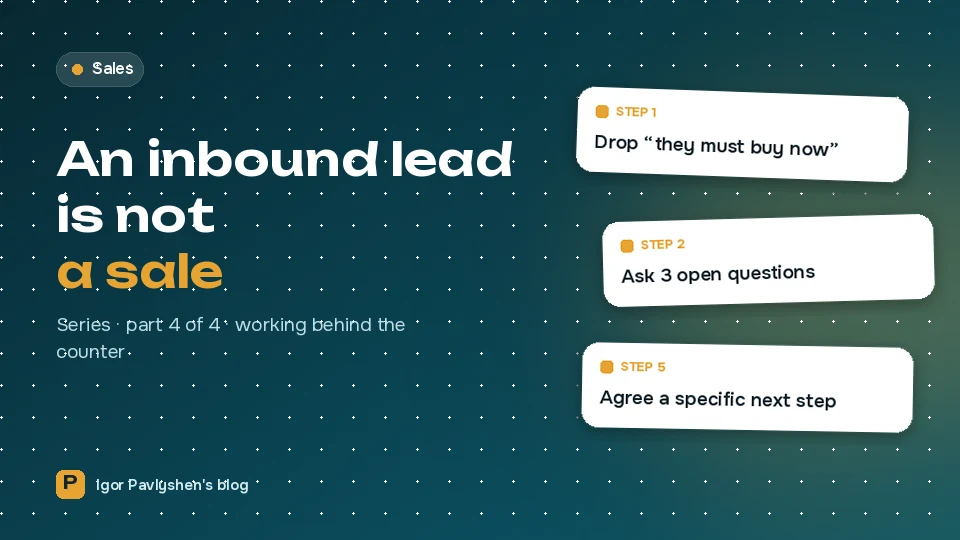
Step 1. Drop the expectation that “they must buy now”. Set the call goal: understand the customer's needs and agree on the next step.
Step 2. Ask at least 3 open questions about context, not just “which trim do you need”.
Step 3. Translate specs into benefits for the customer's specific situation.
Step 4. Check understanding: “Did I get it right that what's critical for you is…?”
Step 5. Agree on a specific next step: time, format, what we send, when we talk again.
A line that replaces pressure and works better
“I won't overload you with dry specs. First I'll understand your situation, then suggest 2–3 options for your exact needs, with a clear benefit and nothing extra.”
It's a simple line, but it instantly changes the tone of the conversation from a hard sell to expert advice.
Checklist for the head of sales and the owner
- On how many calls a week do reps really discover needs rather than read a script?
- Is there a standard of 5 mandatory first-contact questions?
- How many calls end with a specific next step rather than “well, think about it”?
- Are calls reviewed for advice quality, not just for whether a sale happened?
- Does the rep see the customer's context in the CRM to continue the conversation rather than start over?
Until these points are on track, inbound traffic will be systematically under-monetized.
Takeaway
Complex products aren't sold from a “here's the counter, here's the price” position. They're sold through understanding the customer, proper needs diagnosis and skilled guidance to a decision.
A strong rep today isn't a “price list person”. They're a navigator guiding the customer to the right purchase. When the team works this way, conversion grows without constant discounting.
In part 5 (the final one) I'll bring it all together into one system: an owner's checklist for the sales team, quality metrics and a 30-day rollout plan.