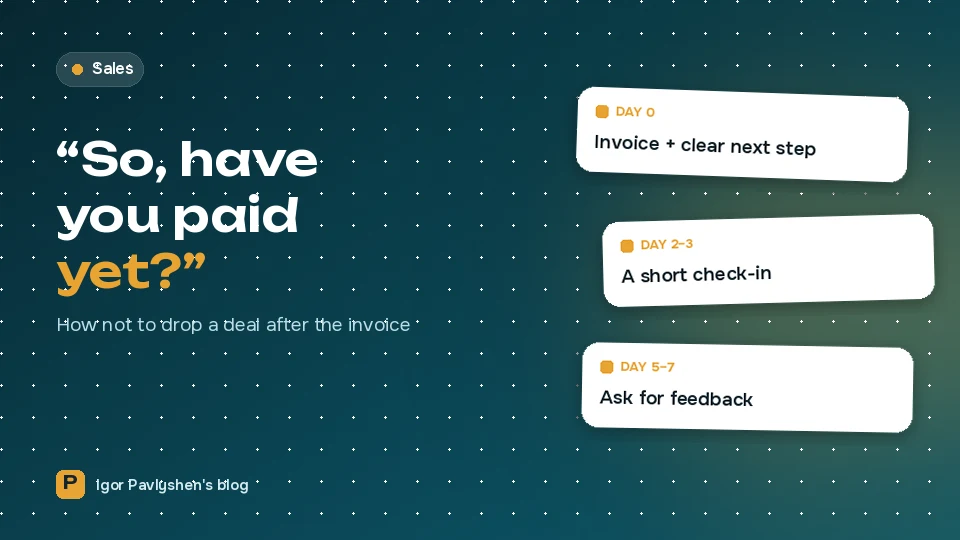
“So, have you paid?” How not to drop a deal after sending the invoice
 Igor Pavlysheninternet marketer
20 November 20244 min read
Contents 7 sections
“So, have you paid?” How one message can drop your product's value and spoil the impression of your company
Honestly, I still don't understand sales reps who message a client the day after sending an invoice: “So, have you paid yet?”
Colleagues, this doesn't speed up payment. Most often it lowers your standing in the client's eyes and puts you in the position of someone asking, not managing the deal.
Why “So, have you paid?” works against you
- You put yourself in a weak position. Instead of an expert and partner, you sound like someone who urgently needs money “to close the deal somehow”.
- Doubts about the product appear. The client reads it as: if they're rushing me like this, maybe the value isn't that great.
- Trust in the rep drops. The conversation starts to sound like a street market: “buy, buy, please”.
This is especially noticeable in B2B, where the decision is often made not by the person who requested the invoice but by the decision-maker. The person may have simply passed the documents on for approval and not know when it'll be paid.
What to understand about invoice payment
If a client requested an invoice, there are usually two scenarios:
- They really intend to pay.
- They've taken the proposal inside the company for approval.
In both cases a “nudge” the next day rarely helps. If the need is urgent (hosting, telephony, a critical service), payment goes through quickly without reminders. If it isn't urgent, payment will come when a window opens inside the company.
So you don't control the timing with “So, what's up?”; you only spoil the impression of your communication.
When you can and should get back to the client
I'm talking about first deals, not recurring payments or services already delivered. In a healthy process the logic is:
- Day 0: send the invoice + clearly state what's included, how long it's valid and the next step.
- Day 2–3: a careful service check-in (if it's a large company or a complex approval).
- Day 5–7: ask for feedback on the decision and the quality of the proposal.
This already looks professional: you're not begging for payment, you're managing the process and helping the client decide.
How to write it right: working phrases
Instead of “So, when's the money coming?” use human, businesslike messages.
Option for day 2–3:
Good afternoon, Mr Smith. A short check-in on invoice No. … dated …
Could you let me know whether the company details and the scope of the proposal are correct, so we can make changes quickly if needed?
Option after a week (if there's no payment):
Good afternoon, Mr Smith.
It's been a week since invoice No. … was sent. Am I right in thinking you've either chosen another option or the need has been postponed?
If you don't mind, share 1–2 comments on what we could improve in our proposal. It will help us make our service better.
Feel the difference? There's no begging here. There's respect, clarity and useful feedback.
What a head of sales should do so the team doesn't “beg”
- Write a post-invoice follow-up policy with day-by-day timing.
- Ban trigger phrases: “So?”, “When's the money?”, “Paid yet?”.
- Add message templates to the CRM, but leave room for personalization.
- Once a week review a sample of conversations and check the tone.
- Judge reps not only by closing pressure but by the quality of the customer experience.
If you don't, reps will waste loyalty and the company will wonder why “there are leads but conversion to money is weak”.
A word about exceptions
Yes, there are exceptions. For example:
- recurring invoices for ongoing work;
- closing documents for a service already delivered;
- urgent projects with a payment date agreed in advance.
There it's fine to check the payment status. But even then the follow-up should stay businesslike, not “please, please”.
Summary
The question isn't whether to message the client after sending an invoice. The question is how and when to write.
A professional rep doesn't beg for payment. A professional rep manages the deal, holds the frame, helps the client through approval and calmly collects feedback if payment doesn't happen.
And yes, “So, have you paid?” almost never speeds up payment. But it very quickly kills the impression that the client is dealing with a strong professional.