A lead is not the enemy: how a car dealer's sales team loses customers on the first call
 Igor Pavlysheninternet marketer
26 March 20256 min read
Contents 7 sections
About the customer. About the product. About the sales team. This is the first part of notes from practice where I look not at advertising itself but at the moment when ads either turn into money or burn into nothing.
As a marketer I regularly listen to calls, read chats and analyze how the sales team handles inbound leads and how well it takes people from interest to purchase. In recent months I've had more automotive projects. I worked in this niche before, but now it's not one-off tasks but full lead generation: ads, website, analytics, inquiry routing and then the reps' actual work.
That's why I decided to write a series. It will be useful for sales reps, heads of sales and owners. Because the problem is almost always the same: marketing is in one trench, sales in another, and the customer gets lost in between.
Why a marketer should listen to calls at all
There's a dangerous illusion: if a lead came in, marketing did its job. In practice a lead is only the first step. After that, communication decides everything. You can bring quality traffic, the right audience and a strong offer and still lose the deal in the first 90 seconds of the conversation.
When I listen to calls, I look not only at the rep. I look at the whole system:
- what the customer expected to hear after submitting a request;
- what they were actually told;
- why the conversation turned into resistance;
- at which stage we lost trust;
- what needs fixing in the script, the product, the presentation, the CRM and communication.
And the most common symptom I hear in different industries, but most vividly at car dealers, is this: the rep sees a lead as a nuisance, not a chance.
1️⃣ A lead isn't a threat. It's the moment the customer chooses whom to stay with
As a rule, many reps see a call, form or chat as an inconvenience. Like: “Why are you calling? Come to the showroom, we'll tell you everything there.” And it's not always laziness. More often it's the old school of sales, where the main goal is to drag the person to the physical location at any cost.
The problem is that the world has changed radically in recent years:
- people are used to getting information instantly and remotely;
- communication has moved to messengers and quick replies;
- customers compare offers on a single screen;
- buying complex products no longer depends on a first in-person visit;
- there are marketplaces that can deliver a car to your door.
Against this background, “Come to the showroom, we'll discuss it there” sounds to the customer not like care but like an attempt to dodge specifics. It works especially badly when the person asks a direct question and gets evasion and “come in” repeated every 30 seconds.
At such moments the conversation turns into a tug of war: the customer pulls toward clarity, the rep toward a visit. And the winner is almost never the one who “pushed harder”, but the one who first gave clear, honest and timely information.
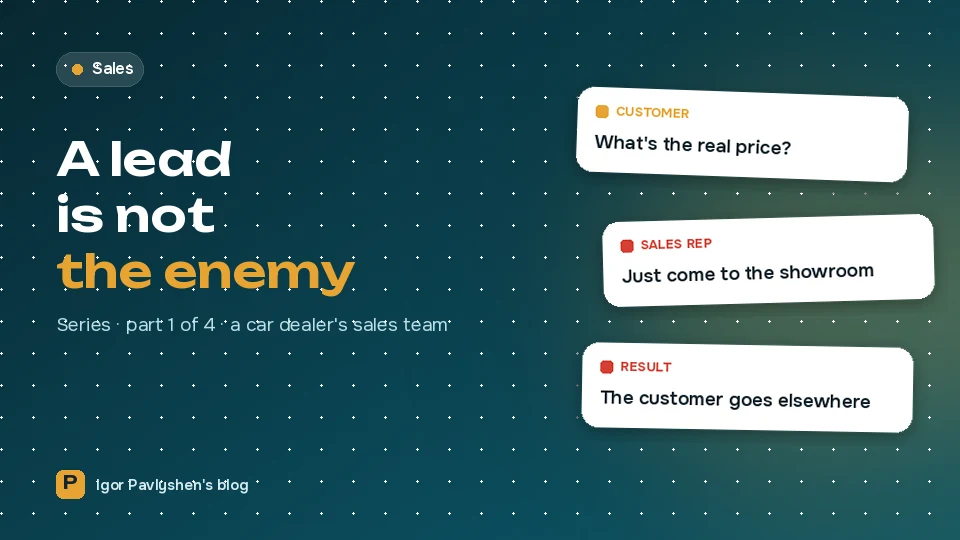
How it sounds on a real call
Customer: Could you tell me which trim is in stock and what the real price is with all the terms?
Sales rep: Come to the showroom, we'll tell you everything there.
Customer: I'm on the other side of town, I need to understand the price range and terms first.
Sales rep: We don't discuss that over the phone, come in.
What the customer hears between the lines:
- “They don't want to give me a straight answer”;
- “So they'll change the price along the way”;
- “I'll probably waste my day off.”
After that the person gets defensive and goes to another dealership that gave them more transparency. Even if it's objectively more expensive there.
How it hurts the business
When a lead is treated as a “punishment from above”, the company loses money in five places at once:
- The ad budget burns. The lead is already paid for but doesn't become a deal.
- The visit rate drops. Because the customer wasn't given a reason to come.
- The share of “cold refusals” grows. Not because of the price, but because of the tone and approach.
- Reputation suffers. People share experiences faster than you think.
- The owner gets a distorted picture. It looks like “the leads are bad”, although the bottleneck is inside the sales team.
What a sales rep can do today
No complex training and no restructuring of the whole team. Start with a basic principle:
First satisfy the need for information. Only then offer the next step.
A working sequence for the first contact:
- Briefly restate the customer's request in your own words.
- Give specifics on what you can right away: availability, price range, key terms.
- Clarify the context: purchase timeline, payment method, priorities.
- Offer a convenient next step: a call at a specific time, a selection of options via messenger, an online presentation.
- Record the agreement in the CRM and actually get back to the customer when promised.
A line that often works better than any closing technique:
“Let's do this: I'll give you the basic picture of the options now, then suggest 2–3 solutions for your request, so you can decide whether it's worth coming to the showroom.”
There's no pressure in this approach. There's respect for the customer's time. And today respect sells better than scripted pressure.
What a head of sales and an owner should do: a short checklist
- Listen to 30–50 calls from the last 2 weeks yourself, unfiltered.
- Measure the share of calls where the customer got specifics in the first 2 minutes.
- Remove KPIs that only reward “getting them to the showroom at any cost”.
- Add KPIs for first-contact quality and keeping commitments.
- Rewrite the rep's 10 opening lines for today's online-first customer.
- Check first-response speed across all channels: calls, forms, messengers, chat.
- Connect marketing analytics to CRM stages to see exactly where leads are lost.
Most importantly: don't split marketing and sales. The customer doesn't care where your “area of responsibility” ends. To them it's one company. If one part made a promise and another pushed them away, the whole system lost.
Takeaway
A lead isn't a threat or a distraction. It's a point of trust. If at that moment the rep helps the person get oriented, explains calmly and honestly and talks without manipulation, the sale becomes a matter of time and follow-up quality.
If the customer is sold a showroom visit instead of an answer to their question, they go where they're heard.
In part two I'll cover the next sore point: how reps “kill” customer interest with a poor product presentation and why even a good offer fails when needs aren't qualified properly.