Product knowledge wins: why sales teams lose deals and how to fix it (Part 3)
 Igor Pavlysheninternet marketer
28 March 20255 min read
Contents 10 sections
- The product they didn't buy
- Why “rereading the website” isn't “knowing the product”
- What a manager should do: sell knowledge, not just a script
- A mini cheat sheet for reps: how to talk about the product
- Add-on products that hurt instead of sell
- Why this breaks trust instantly
- How to include add-on products without toxic pushing
- A line that usually saves the conversation
- Checklist for the owner and head of sales for the next 2 weeks
- Takeaway
About the customer. About the product. About the sales team. (Part 3) Background: Part 1 and Part 2.
In this part I'll cover two more blocks that keep coming up in call reviews. Both hit revenue directly: reps don't know the product well and can hardly sell add-on solutions properly.
🧂 The product they didn't buy
A bit of personal history. I once worked for a large mobile phone retailer. Back then the iPhone was almost an “odd toy” for the mass market: people mostly chose Samsung, Nokia, LG. I also sold whatever paid better. Until one day an iPhone ended up in my hands.
I started digging deeper: the interface, use cases, limitations, jailbreaking, extra services, accessories. After that iPhone sales at my store grew noticeably. The reason is simple: when you really understand a product, you stop reading specs and start explaining the benefit in the customer's language.
A salesperson who doesn't know the product, hasn't lived with it and doesn't get the nuances sells poorly. Not because they're lazy, but because they have nothing to argue the value with confidently.
Why “rereading the website” isn't “knowing the product”
On many calls I hear the same scenario: the rep literally reads out the product page from the website. Power, drivetrain, gearbox, engine size, trim. Formally it's all correct. Practically it's useless.
Customers don't compare numbers, they compare solutions to their problem. They need to understand:
- whether the product fits their real life;
- which risks it removes and what everyday benefits it brings;
- what the difference between options is for them specifically, not “in general”;
- where they can save and where they'd better not.
Without this, the call becomes a mechanical list of specs, after which the customer leaves “to think about it” and usually disappears.
What a manager should do: sell knowledge, not just a script
Not every rep needs to buy a test car. You need systematic immersion in the product.
- Internal product sessions once a week. Not a theory call but a review of real customer cases.
- Demo days. Show the product in action: test drives, real-use scenarios, trim comparisons.
- Quizzes and mini assessments. A short check of who really understands the differences and benefits and who memorized the price list.
- A library of “specs translated into benefits”. Not “238 hp” but “which problem this solves for this particular customer”.
- Call reviews with feedback. Based on facts: where the rep faltered, where they hit the mark, what to fix next time.
When the team truly knows the product, it's not only conversion that changes. The tone changes. Calm confidence appears in the voice, and that's one of the strongest trust factors.
A mini cheat sheet for reps: how to talk about the product
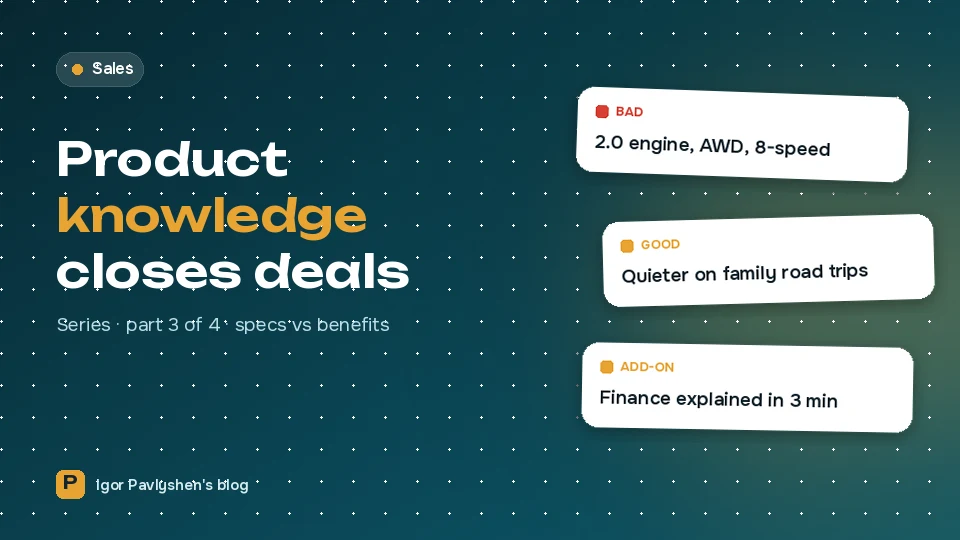
Bad approach: “We have a 2.0 engine, all-wheel drive, an 8-speed gearbox.”
Working approach: “If you often drive on the highway with family and luggage, this option is quieter and more stable at speed, and cheaper to own for the way you drive.”
That is: the customer's context first, then the spec, then the benefit for their life. In this order selling starts to work.
🧂 Add-on products that hurt instead of sell
Finance, mortgages, trade-in, insurance, service packages: in the owner's logic these boost the deal and add margin. In the logic of part of the sales team, they're “extra work” they're forced to upsell.
The problem becomes critical when the rep barely knows the main product and is even shakier on partner products. As a result, a customer ready for a big purchase doesn't get proper advice on how to make it happen.
It's funny and sad at the same time when a home seller doesn't know basic mortgage terms although a large share of deals go through mortgages. Or when a car dealership rep can't clearly explain how a trade-in affects the final price.
Why this breaks trust instantly
- The customer feels their financial situation isn't understood.
- The answers sound vague and contradictory.
- It feels like the terms will be “adjusted on site” and changed along the way.
- It feels like pressure instead of guidance.
For the customer this isn't an “upsell”. It's part of the solution that decides whether they can buy at all.
How to include add-on products without toxic pushing
- Map the purchase scenarios. Cash, finance, mortgage, trade-in, combinations. The rep should see the deal route, not guess along the way.
- Provide ready-made finance calculators. Monthly payment, total interest, term, down payment: fast and transparent.
- Prepare 10 typical cases with numbers. “Customer A with income X chose option Y because…”
- Assign someone responsible for keeping terms up to date. Rates and partner programs change, so the information must be updated daily.
- Introduce a rule: benefit first, then the tool. Not “we'll arrange finance” but “with this option you stay within a comfortable monthly payment and don't postpone the purchase for a year”.
A line that usually saves the conversation
“Let's pick not just a model but a comfortable way to buy it for your budget and timeline. I'll give you 2–3 transparent options with numbers so you can compare calmly and decide without surprises.”
This approach relieves tension and brings the conversation back to advice rather than pressure.
Checklist for the owner and head of sales for the next 2 weeks
- Listen to at least 40 calls and separately score “product knowledge”.
- Measure the share of calls where the rep turns specs into benefits.
- Check how the team explains finance, mortgage and trade-in in the first 3 minutes.
- Remove abstract KPIs and add metrics for advice quality.
- Start a weekly product session with mandatory practice.
If a customer can't get a clear explanation of how to buy, they'll go where people speak to them clearly, even if it costs more there.
Takeaway
Sales don't drop only because of traffic. Very often the bottleneck is the reps' product knowledge and weak handling of add-on solutions.
A strong sales team is one where reps know the product deeper than its web page and can connect it to the customer's problem, emotions and budget. Then advice turns into trust, and trust into a deal.
In part 4 I'll continue: how teams waste inbound demand after the first contact and why “I'll call you back later” usually means losing the customer.