Why marketing needs a full-funnel approach: how not to depend on one channel
 Igor Pavlysheninternet marketer
4 April 20265 min read
Contents 5 sections
Why marketing needs a full-funnel approach: a guide for businesses that want to grow, not just survive
People often come to me with a narrow request: “We need ads set up.” For many it looks like a cure-all: launch the ads and paying customers start knocking on the door.
The good news: search ads really can deliver. The bad news: as the only pillar of a business it's too fragile. Sometimes it works, sometimes it works for a while, and sometimes the market and the platform change the rules faster than you can adapt.
Below I explain why “one channel for everything” is a risk and the minimum set you need before buying paid traffic, so you don't live in constant panic.
Why you can't build marketing on search ads alone
1. Every ad channel is unstable
Search ads are a channel, not a guarantee. Even on big budgets there are periods when everything flies, and then at some point the system stops delivering the volume and quality of leads you need.
I had a car import case with a budget of about $15K a month. The campaign worked right up to the moment the ad platform “changed its mind” about conversions. Rebuilding the structure, reloading the setups and getting the numbers back took a month and a half.
It didn't kill the project only because other sources were already running in parallel: social ads, messenger ads and data-platform audiences. If search had been the only channel, there would have been a lead drought and a cash-flow hit.
2. Search ads have become expensive
In recent years the cost of clicks and leads in competitive niches has risen noticeably. On a limited budget the channel gets fickle: one step off and the economics stop adding up.
Meanwhile, part of the audience you overpay for in search can be reached cheaper in other channels: same people, just a different context.
3. Diversification isn't theory, it's insurance for the business
Any investor will tell you: putting all your eggs in one basket is dangerous. Marketing works the same way. One channel can dip because of the auction, moderation, the algorithm, seasonality, competitors or a simple technical error.
If you have 3–5 working lead sources, a dip in one doesn't become a disaster. That's mature marketing over the long run.
Where to start so your ads aren't multiplied by zero
You can set up campaigns perfectly, but if you send traffic to a “DM us for the price” or “our discounts are so secret even we won't show them” website, the results will be very modest.
Ads don't work on their own. They work together with everything around the business.
1. Set up your presence on maps and directories
The minimum: Google Business Profile, Apple Maps, Bing Places and your industry's directories. People should find you by simply searching your name, not through a quest.
A complete listing with photos, contacts, opening hours and services builds trust faster than any banner ad.
2. Reviews are the foundation, not “we'll collect them later”
If your business isn't in search results with a decent number of reviews, you're already losing to more systematic competitors.
The reality is simple: as customers, we all scour reviews before buying. Your customers do exactly the same.
So the process must be built into operations:
- sold a product or service, asked for a review;
- sent a reminder after a while;
- connect a CRM, email campaigns and automatic triggers to collect feedback.
3. Build a website that doesn't annoy people
You don't have to build a “spaceship” for a fortune right away. But a basic website must answer the customer's key questions:
- a clear offer;
- what services or products you offer;
- starting or current prices;
- reviews;
- contacts and company information.
If the website makes people suffer, any paid traffic will cost more and convert worse.
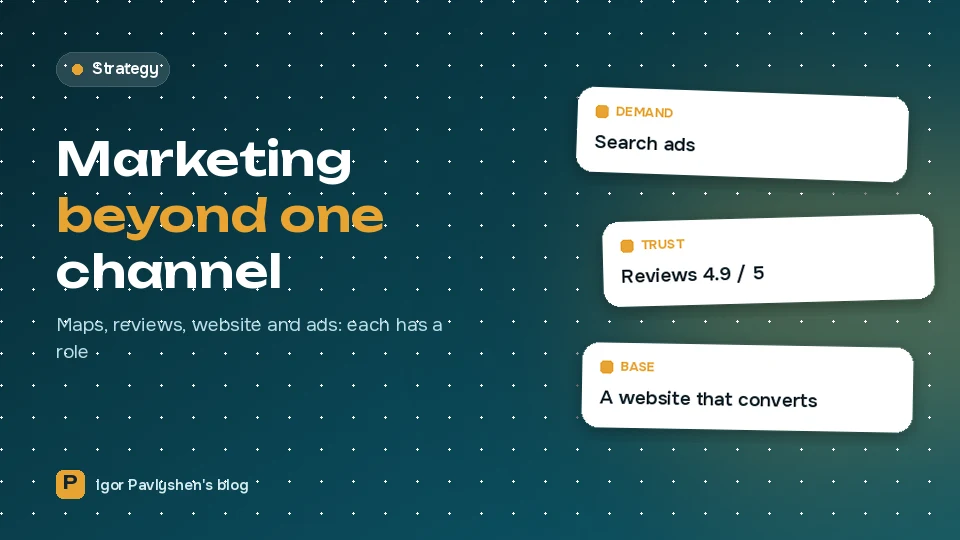
4. Give each channel a role
Not every channel should do the same thing. A working model usually looks like this:
- some channels for immediate demand;
- others for warming up and touchpoints;
- others for retargeting and bringing back leads that didn't convert.
Search ads, social ads, messengers, marketplaces and audience data platforms aren't “either-or”. They're a toolkit for different funnel stages.
The practical minimum before buying paid traffic
- Reviews: collect them systematically, not occasionally.
- Directories and review sites: fill them in fully and neatly (logo, photos, services, contacts, messengers, hours).
- Website: simple and clear, with an offer, prices and contacts.
- Channels: don't bet everything on one source; prepare backup channels.
This isn't “perfect marketing”. It's the basic hygiene without which you're paying for chaos.
What matters most in the long run
Even if everything is great in one channel today, it can end tomorrow. Rebuilding the funnel, creatives, analytics and processes takes time, and sometimes the business simply doesn't have that time.
A full-funnel approach isn't a buzzword. It's how you make marketing manageable and the business resilient to dips and platform surprises.
Summary
In 2026 the winner isn't whoever “set up one ad account best”. The winner is whoever built a system: reputation + infrastructure + several channels + proper analytics.
If you want steady growth rather than a roller coaster, treat marketing as an ecosystem. Then a dip in one tool won't switch off your sales.