The perfect brief before launching ads: how to collect data without endless questionnaires
 Igor Pavlysheninternet marketer
24 December 20254 min read
Contents 5 sections
How do you create the perfect brief before launching ads?
Spoiler: you just can't. And that's fine. There's no perfect brief, just as there's no perfect client who happily fills in 78 fields in a Google Form after work.
The most common mistake of contractors and marketers is trying to collect “everything at once” in a form nobody reads afterwards. At best they'll ask about the same data ten more times. At worst the form is closed, the file goes into a “Briefs” folder and is forgotten forever.
Why you need a brief at all (and why you don't)
A brief isn't bureaucracy for its own sake. Its job is to sync the client's reality with your working model before the budget starts.
Honestly, a brief has two functions:
- operational: so the team understands what we're promoting, to whom, where and for how much;
- legal and psychological: so nobody later plays the “that's not what we agreed” game.
The problem is that a brief “useful for the specialist” is too complex for the client, and one “convenient for the client” is often useless for launching.
So you don't have to choose between “very smart” and “very simple”. You need a hybrid model.
A working brief model: 3 steps that actually get the job done
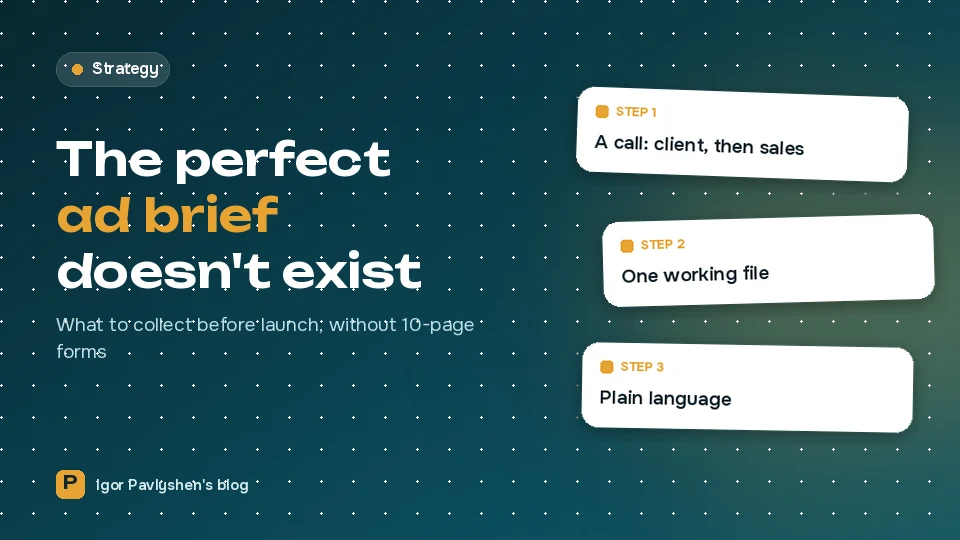
1. A call: first the client, then the sales team
The best format is a video or audio call. First with the client separately, then with the sales team separately. Otherwise the meeting easily turns into 4 hours of chaos where everyone talks and nothing gets decided.
What a call gives you:
- context that would never make it into a form;
- hypotheses and ideas on the fly;
- a clear explanation of “how this is going to work”;
- screen sharing with examples, the funnel and the launch logic.
Tip: record your meetings. Later it saves nerves, deadlines and “oh, I understood it differently” threads.
2. Record the basics in one working file
After the call, record the basic data in the client's own words. No embellishment, no fluff. I usually keep the minimum that's really needed at the start:
- who's responsible and who makes final decisions;
- opening hours, phones, messengers;
- addresses, branches, ad geography;
- budget, constraints, deadlines;
- advantages, offers, weak spots, seasonality;
- what counts as success in numbers.
It's convenient to keep this in a mind map or a short 1–2 page working document. What matters isn't looking pretty but that the team really uses it every day.
3. Talk to the client like a human
I've seen hundreds of calls where the contractor pours out jargon as if defending a PhD thesis. Meanwhile the client sits there with a “-_-” face, with no idea what's going on.
Our job isn't to impress the client with complicated words. Our job is to help them solve their problem.
Translate complex things into plain language:
- CPC — the average cost of one click;
- LTV — how much a customer brings the business on average over their lifetime;
- CR — the percentage of people who took the target action;
- ROMI — how much money came back from the ad spend.
When the client understands what you're doing, they make decisions more calmly, approve hypotheses faster and slow the launch down less.
The questions really worth asking before the start
- What do you want to get in money, leads or deals in 30–90 days?
- Which products or services are your priority right now?
- Which channels have you tried and why weren't you happy with the results?
- Where is the funnel breaking now: ads, landing page or lead handling by the sales team?
- Which constraints are critical: budget, timing, regions, resources?
These 5 questions give more value than 50 checkboxes in a form.
Checklist before launching ads
- There's one agreed file with the project basics.
- It's clear who makes the yes/no call on hypotheses.
- KPIs for the first stage and the evaluation timeline are agreed.
- The sales team knows how to handle the inbound flow.
- The client understands the stages: test → analysis → scaling.
Without these you can still launch, but you'll have to come back and fix the foundation later.
Takeaway
You don't need a perfect brief. You need a working brief: short, clear and alive, gathered on a call and recorded in a clear structure.
Remember a simple thing: people are lazy. Nobody wants to fill in endless forms with confusing questions. People want to be heard and helped with their problem. If you can do exactly that, the project starts fast, without a circus and unnecessary pain.