Red flags for clients: how to choose a marketer and not buy “success theater”
 Igor Pavlysheninternet marketer
2 April 20266 min read
Contents 10 sections
- Flag #1. Promises the moon before auditing the project
- Flag #2. Doesn't ask uncomfortable questions
- Flag #3. Flawless case studies with no pain, tests or mistakes
- Flag #4. Throws around jargon to look smarter
- Flag #5. A narrow toolkit and autopilot work
- Flag #6. Too cheap for the scope of work
- Flag #7. No team, but promises “I'll do it all myself”
- Flag #8. Bends over backwards and agrees to everything
- What to ask a marketer before starting: a quick filter
- Summary
Red flags for clients: how to choose a marketer and not buy “success theater”
I often see posts about client red flags from the specialist's point of view. But almost nobody talks about the other side: which red flags the client should noticewhen choosing a marketer for their business.
Below is my personal view, built from practice, mistakes, wasted budgets and working projects. It's not the ultimate truth but a practical filter that saves nerves and money.
Let's not beat around the bush and get to the point.
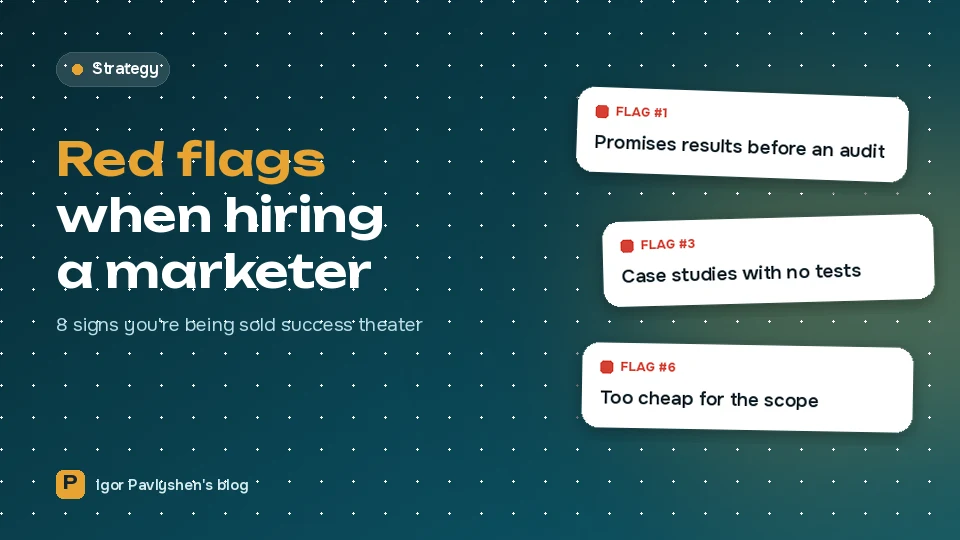
🚩 Flag #1. Promises the moon before auditing the project
If a marketer says “we'll get you 500 leads at $4 each” at the start, without seeing your analytics, CRM, funnel or product, that's a warning sign.
Marketing is a system with lots of variables that neither the client nor the specialist fully controls:
- the economic situation and seasonal demand;
- how much the product is in demand at the moment;
- the real competitive field (including indirect competitors);
- audience behavior, which is always unpredictable.
A simple example: you advertise laminate flooring, but you don't compete only with other laminate sellers. You compete with vinyl, tiles, poured floors, marketplaces, chains and local crews selling turnkey renovation. People's attention goes wherever the benefit is clearer at that moment.
Takeaway: a good marketer doesn't promise “success theater” before diagnosing. They ask questions first, then form hypotheses, ranges and a test plan.
🚩 Flag #2. Doesn't ask uncomfortable questions
If on the call the specialist talks mostly about themselves and asks almost nothing about your business, run.
An experienced marketer usually digs deep:
- the current cost per lead or conversion and how it was calculated;
- what's been tried and why it didn't take off;
- how the sales team handles leads;
- the real unit economics: margin, LTV, sales cycle;
- whether there's a CRM, end-to-end analytics and correct attribution.
The more specific the questions, the more likely you're dealing not with a button-pusher but with someone who thinks in systems.
🚩 Flag #3. Flawless case studies with no pain, tests or mistakes
When you're told “on day one we got a zillion leads for $100 and it only got better”, it's either a fairy tale or a half-truth.
Real projects always go through:
- test budgets burned;
- failed hypotheses;
- reworking landing pages;
- revising offers and creatives;
- sales team problems that break even good traffic.
Ask the specialist to walk you through 2–3 case studies not as “the result” but as “how we got there”: what didn't work, what changed, where money was lost and what lessons were learned.
If there are no such specifics, the case studies have probably been polished for the pitch.
🚩 Flag #4. Throws around jargon to look smarter
When a meeting is flooded with buzzwords like synergy, growth hacking, omnichannel, touchpoints and frameworks, that's a double red flag.
Why:
- the specialist doesn't care whether the client understands them;
- weak expertise often hides behind complicated words.
Marketing can be explained in plain human language. If someone can't translate “smart terms” into practical actions for the business, there will be constant misunderstandings.
The rule is simple: the simpler and more specific the explanation, the more likely you're dealing with a practitioner, not a talking slide deck.
🚩 Flag #5. A narrow toolkit and autopilot work
A marketer's value isn't only in setting up ads. It's in seeing more growth levers than one ad account.
Today's working toolkit is a combination of:
- CRM and automation;
- analytics and end-to-end reporting;
- websites, landing pages and widgets;
- email and messenger marketing;
- non-standard acquisition channels;
- AI and production tools.
If a specialist offers the same “push a button in the ad account and wait” scheme in every niche, you'll probably get a template approach. Marketing is always about adapting to a specific business and a specific funnel.
🚩 Flag #6. Too cheap for the scope of work
This is unpopular, but I'll say it straight: if you're promised a full strategy, setup, contractor management, analytics, content direction and sales growth for “symbolic money”, there won't be any miracles.
Ask yourself honestly: would you work full-time, five days a week, fully accountable for results, for that budget? If not, the specialist probably has too many projects and limited involvement.
A low price is almost always paid for with your time, revisions and lost speed.
🚩 Flag #7. No team, but promises “I'll do it all myself”
Marketing in a real business is a team sport. You need at least a designer, a developer, a paid media specialist, and sometimes an analyst and a project manager.
Two dangerous scenarios:
- the marketer has no permanent team and uses “random freelancers” every time;
- the marketer claims to be a strategist, designer, search ads specialist, social ads specialist and senior developer all at once.
There are exceptions, but they're rare. In most cases this leads to uneven quality and missed deadlines.
🚩 Flag #8. Bends over backwards and agrees to everything
If a specialist tries to win the project on any terms and always says “yes, of course, we'll do it all”, that's not service, that's a warning.
A healthy way to work is a win-win partnership dialogue:
- the marketer may disagree with reasons;
- the client may disagree in return;
- both sides look for common working ground.
Only this way do you get long-term growth rather than an imitation of busy activity.
What to ask a marketer before starting: a quick filter
- What are the 3 main reasons previous campaigns might not have worked?
- How will you check lead quality and the sales team's work?
- Which hypotheses do we test first, and how will we know a hypothesis is dead?
- Which metrics will be key in the first 30/60/90 days?
- Who in the team is responsible for design, tech, analytics and traffic?
- In what format and how often will you report so I see the real picture?
If the answers are vague, like “we'll figure it out later”, you already have your signal.
Summary
When you choose a marketer, you're not choosing “someone to launch the ads”. You're choosing a partner who will affect your company's money, processes and growth rate.
A strong specialist doesn't sell you illusions. They ask uncomfortable questions, work with facts, are honest about risks and build a system where decisions are based on data, not hope.
If you sense falseness, fuss and promises that “everything will be perfect”, better leave the conversation right away. It's cheaper than fixing the consequences later in your budget, analytics and sales.